

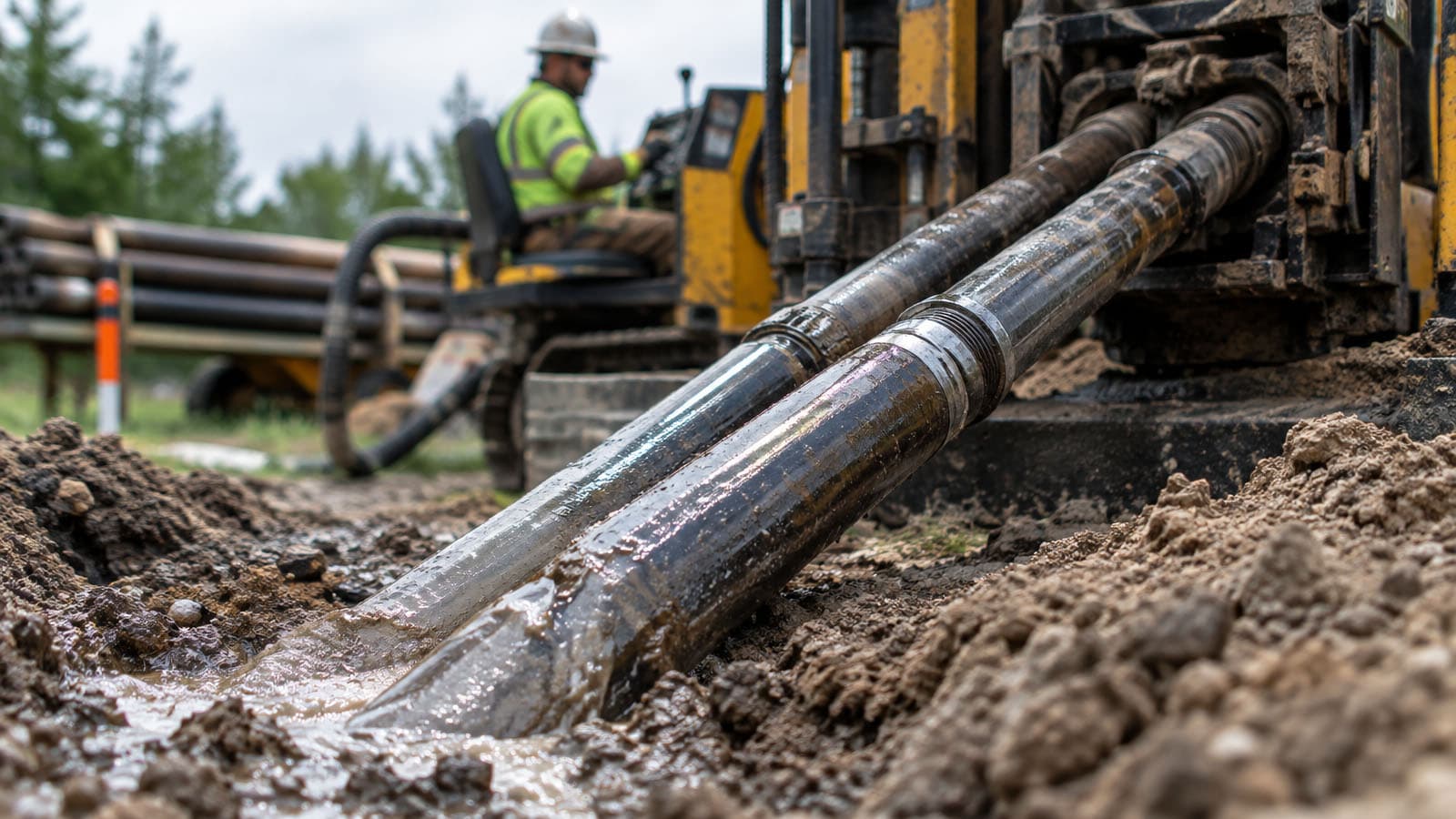
Directional Drilling Method: No-Dig Pipe Installation
.png)
🆕 New Installation Technology
HDD creates NEW utility corridors • Cannot rehabilitate existing pipes
Directional drilling—also called horizontal directional drilling or HDD—represents a fundamentally different trenchless application than the rehabilitation methods like CIPP pipe lining or pipe bursting that repair or replace existing pipes. HDD installs new pipes where none existed before, creating underground pathways through controlled drilling that steers around obstacles, crosses under rivers and roads, and reaches destinations without continuous surface trenching.
The critical distinction between installation and rehabilitation technologies determines when HDD applies versus other trenchless methods. HDD creates new utility corridors—installing water mains to new developments, placing gas lines across rivers, routing fiber optic conduit under highways, or establishing sewer connections where traditional trenching proves impossible or prohibitively expensive. In contrast, rehabilitation methods address existing pipes requiring repair, reinforcement, or replacement.
When HDD beats traditional open-cut installation becomes clear through obstacle analysis and total project cost comparison. Installing utilities across rivers, under active roadways, through environmentally sensitive areas, or beneath buildings demands either extensive excavation with massive restoration costs or trenchless installation avoiding surface disruption entirely. HDD typically costs $50-150 per linear foot—potentially more than open trenching per foot but far less when accounting for pavement restoration, traffic control, environmental permits, and site restoration that excavation demands.
Understanding Directional Drilling Technology
Directional drilling creates underground pathways through a sophisticated three-phase process: drilling a small-diameter pilot hole along a precisely-planned path, enlarging that pilot hole to accommodate the desired pipe size, and pulling the new pipe through the enlarged bore hole. This systematic approach allows installing pipes hundreds or thousands of feet with entry and exit points as the only surface access required.
Steerable Drill Heads:
The pilot hole drilling phase uses steerable drill heads guided by electronic tracking systems. The drill operator receives real-time position data showing the drill head's exact location, depth, and orientation, allowing constant course corrections maintaining the planned path. This steering capability enables navigating around existing utilities, following curved paths, and reaching precise exit locations—capabilities impossible with conventional straight-bore methods.
Drilling Mud Circulation:
Drilling mud circulation throughout all phases serves multiple critical functions: cutting removal from the bore hole, bore hole wall stabilization preventing collapse, drill bit cooling and lubrication, and providing hydraulic pressure assisting steering. The mud composition—typically bentonite clay based—requires careful formulation for specific soil conditions and project requirements.
| Factor | HDD Method | Traditional Excavation |
|---|---|---|
| Surface Disruption | Two small pits (8x20 ft each) | Continuous 3-4 ft wide trench |
| Per-Foot Cost | $50-150/ft (drilling) | $20-40/ft (excavation only) |
| Restoration Costs | Minimal - small pit restoration | $30-100/ft pavement replacement |
| Traffic Control | None - boring underneath | $10,000-50,000+ per project |
| Timeline | 5-7 days typical | 4-6 weeks for 1,000 ft |
| Environmental Impact | 320 sq ft disturbed (2 pits) | 12,000+ sq ft for 1,000 ft run |
| Total Cost (1,000 ft) | $75,000-100,000 | $175,000-215,000 w/ restoration |
Total Cost Advantage: While HDD costs $50-150/ft for drilling versus $20-40/ft for open trenching, total project costs often favor HDD by 30-50% when accounting for pavement restoration, traffic control, environmental permits, and extended timelines. For obstacle crossings or sensitive areas, HDD delivers exceptional total cost savings.
⚠️ Critical Distinction:
HDD installs NEW pipes where none existed, creating utility corridors from scratch. Pipe bursting replaces existing pipes. CIPP lining rehabilitates existing pipes. These fundamental differences mean project requirements—new installation versus existing pipe rehabilitation—drive primary method selection before cost or other factors enter consideration.
For new installations, HDD competes primarily with open-cut trenching or micro-tunneling. For existing pipe issues, rehabilitation methods like CIPP, pipe bursting, or slip lining represent appropriate technologies. Understanding this distinction prevents proposing HDD for pipe rehabilitation or suggesting CIPP for new installations—fundamentally mismatched applications.

The Three-Phase HDD Process
The process begins with drilling a small-diameter pilot hole—typically 3-6 inches—along the planned path from entry to exit point. This pilot hole establishes the route that subsequent reaming and pipe installation will follow.
Steerable Drill Head Guidance:
A beacon mounted behind the drill bit transmits signals to surface receivers, providing real-time data on position, depth, pitch, and heading. The operator monitors this data continuously, making steering adjustments by changing the drill bit orientation and drilling parameters. This constant feedback and correction maintains the planned path within tolerances typically ±12 inches horizontally and ±6 inches vertically.
Advanced Tracking Systems:
Tracking and monitoring systems have evolved from simple walk-over locators to sophisticated computer-aided guidance providing 3D visualization of drill path relative to planned route and existing utilities. Advanced systems integrate GPS positioning, multiple tracking technologies, and real-time path calculation showing required corrections before deviations become problematic.
Once the pilot hole reaches the exit point, reaming enlarges it to accommodate the pipe being installed. Reamer selection bases on final pipe size plus adequate clearance—typically 1.5-2 times pipe diameter for smaller pipes, 1.3-1.5 times for larger installations.
Progressive Reaming:
Multiple reaming passes may be required for large pipes or difficult soils, with each pass enlarging the bore incrementally. Progressive reaming proves easier and more controllable than attempting single-pass enlargement to final size.
Bore Hole Conditioning:
Bore hole conditioning through mud circulation becomes increasingly important as hole size increases. Larger bores demand more mud volume maintaining pressure, removing cuttings, and preventing collapse. Mud properties—viscosity, density, filtration characteristics—require monitoring and adjustment throughout reaming.
With the bore hole reamed to size, the final phase pulls the new pipe through from exit to entry. The pipe—typically HDPE for flexibility—is attached to the reamer/pulling head assembly at the exit pit, with the drill rig at the entry pit providing pulling force.
Pulling Force Calculations:
Typical residential HDPE pipe might handle 10,000-20,000 lbs pulling force, while heavy-wall products for larger installations can exceed 100,000 lbs. Monitoring actual pulling forces throughout installation ensures they remain within safe limits.
Upon completion, camera inspection may verify proper installation and pipe integrity before connecting to existing infrastructure.

Applications & Uses
Perfect HDD Candidates:
- River crossings: Installing under waterways without surface disruption
- Highway crossings: Boring under active roadways without traffic impact
- Railroad crossings: Avoiding complex track shutdown coordination
- New utility installations: Water mains, gas lines, fiber optic, electrical conduit
- Sensitive areas: Wetlands, parks, historical sites with minimal impact
- Longer runs (300+ feet): Economy of scale distributes mobilization costs
River, road, and railroad crossings showcase HDD's signature capability. Installing utilities under these obstacles via traditional methods demands extreme expense—river cofferdams, highway closures with complex traffic control, railroad coordination and track shutdowns. HDD simply drills underneath at depths providing adequate cover, avoiding surface complications entirely.
HDPE Pipe (Dominant Choice):
HDPE pipe dominates HDD installations due to flexibility allowing pullback through curved bore paths, fusion-welded joints creating continuous pulls without weak points, and resistance to pulling forces without damage. The material's properties make it nearly ideal for HDD applications.
Steel Pipe:
Steel pipes install via HDD for specific applications requiring strength or pressure ratings beyond HDPE capabilities, though reduced flexibility limits bore path curvature.
Telecommunications Conduit:
Telecommunications conduit—HDPE or PVC—represents substantial HDD market share for fiber optic networks.
Advantages and Limitations
- No continuous trenching: 98% reduction in surface disruption
- Obstacle crossing: Rivers, highways, buildings crossed without surface impact
- Minimal environmental impact: Small entry/exit pits only
- Zero traffic disruption: Boring underneath, no lane closures
- Faster installation: 5-7 days vs 4-6 weeks for challenging projects
- Total cost savings: 30-50% savings despite higher $/ft drilling
- Precision steering: ±12 inch horizontal, ±6 inch vertical accuracy
- New installations only: Cannot rehabilitate existing pipes
- Specialized equipment required: Limits contractor availability
- Soil condition dependent: Rock, coarse gravel, loose sand challenge success
- High mobilization costs: Makes short runs (<200-300 ft) uneconomical
- Entry/exit pits required: Still need excavation at both ends
Costs & Pricing
Directional drilling typically costs $50-150 per linear foot for common utility installations. River crossings, rock drilling, or extreme depths can push costs to $200-500+ per foot.
Economy of Scale:
Project length critically impacts pricing because mobilization costs ($15,000-40,000 typical) distribute across footage. A 200-foot bore might cost $150/ft total ($30,000), while a 2,000-foot bore costs $70/ft ($140,000)—same mobilization but 10x the production footage.
Example: 1,000-foot Highway Crossing
HDD Total: $75,000-100,000 (drilling + minimal restoration)
Open-Cut Total: $175,000-215,000 (excavation + pavement + traffic control + restoration)
HDD Savings: 30-50% on total installed cost
Frequently Asked Questions
Directional drilling commonly reaches depths of 10-50 feet for utility installations, with specialized equipment capable of 100+ feet for specific applications. Maximum depth depends on drill rig capacity, soil conditions, and tracking system range.
Yes, river crossings represent one of HDD's signature applications. The drill path routes beneath the riverbed at depths providing adequate cover (typically 10-20 feet minimum below lowest anticipated scour depth), avoiding the extreme expense and complexity of surface river crossing methods.
HDPE pipe works best for HDD due to flexibility and fusion welding. Steel pipe installs successfully but with curvature limitations. PVC conduit works for telecommunications. The key requirement is withstanding pulling forces without damage while maintaining flexibility for curved bore paths.
HDD typically costs more per linear foot than open trenching ($50-150 vs $20-40/ft), but total project costs often favor HDD by 30-50% when accounting for pavement restoration, traffic control, environmental permits, and longer timelines that excavation requires.
Modern HDD achieves remarkable accuracy—typically ±12 inches horizontal and ±6 inches vertical over hundreds of feet. Advanced guidance systems with continuous tracking and 3D visualization enable operators to maintain planned paths within tight tolerances.
Conclusion: HDD as Installation Solution
Directional drilling fills the critical niche of installing new utilities where traditional trenching proves impossible, prohibitively expensive, or environmentally unacceptable. The technology's ability to cross rivers, route under highways, and navigate sensitive areas while minimizing surface disruption makes it indispensable for modern infrastructure development. However, HDD suits only new installations—it cannot rehabilitate existing pipes, making it complementary to rather than competitive with rehabilitation technologies.
Understanding when HDD makes sense requires evaluating obstacle presence, project length (longer favors HDD), environmental sensitivity, and total project costs including restoration. For new utility installations facing significant obstacles or surface restrictions, HDD frequently provides the only technically and economically viable solution. For additional context on trenchless solutions, explore our comprehensive technology guides.
Ready to Find HDD Contractors?
Connect with experienced directional drilling contractors for new utility installations and obstacle crossings.
Find HDD Specialists