

Complete Guide to Trenchless Repair Methods

When sewer pipes fail, property owners face a critical decision: how to repair or replace damaged underground infrastructure without destroying their property. Traditional excavation methods require digging large trenches, destroying landscapes, driveways, and hardscaping in the process. Fortunately, modern trenchless repair methods offer a better solution.
Trenchless repair methods encompass a range of innovative techniques that repair, rehabilitate, or replace underground pipes with minimal surface disruption. These no-dig technologies have revolutionized the plumbing and infrastructure industries, offering property owners faster, less invasive, and often more cost-effective solutions than traditional excavation.
This comprehensive guide explores every major trenchless repair method available today, from the widely-used CIPP pipe lining to specialized techniques like precision micro-tunneling. Whether you're a homeowner dealing with a failing sewer line or a property manager evaluating infrastructure rehabilitation options, understanding the full spectrum of trenchless technologies will help you make informed decisions about your pipe repair needs.

Understanding Trenchless Technology
For decades, repairing underground pipes meant one thing: dig them up. Traditional excavation required backhoes, trenches extending the entire length of the damaged pipe, and weeks of restoration work to repair the landscape damage. The process was expensive, disruptive, and time-consuming.
Trenchless technology emerged in the 1970s and gained widespread adoption in the 1990s as engineers developed innovative ways to rehabilitate pipes from the inside or replace them with minimal surface access. Today's trenchless methods represent decades of engineering refinement, combining advanced materials science, robotics, and installation techniques to deliver long-lasting repairs without the destruction associated with traditional digging.
Trenchless repair methods fall into two primary categories: rehabilitation and replacement. Rehabilitation methods like CIPP pipe lining create a new pipe within the existing damaged pipe, while replacement methods like pipe bursting break apart the old pipe and simultaneously install a new one.
Most trenchless projects begin with camera inspection to assess pipe condition and identify damage locations. Contractors then clean pipes using hydro jetting equipment before installing the new liner or replacement pipe. The entire process typically requires only small access points at pipe entry and exit locations rather than continuous trenching.

Key Benefits Over Traditional Digging
- No landscape destruction: Preserves lawns, gardens, driveways, and hardscaping that would otherwise require expensive restoration
- Faster installation: Most trenchless repairs complete in 1-3 days versus 1-2 weeks for traditional excavation
- Lower total cost: When factoring in restoration expenses, trenchless methods often cost 30-50% less than dig-and-replace
- Minimal disruption: Property remains accessible during repairs with no large equipment blocking driveways or streets
- Long-lasting results: Modern trenchless repairs carry 50-100 year warranties and often outlast traditional pipe replacement
Primary Trenchless Repair Methods

CIPP pipe lining stands as the most widely-used trenchless repair method in North America, accounting for approximately 60% of all trenchless rehabilitations. This innovative technique creates a new pipe inside the existing damaged pipe using a flexible liner saturated with epoxy resin systems.
The CIPP process begins with thorough pipe cleaning and inspection. Contractors then insert a felt tube liner saturated with liquid epoxy resin into the damaged pipe. The liner conforms to the pipe's interior shape—including navigating bends and offsets—before being inflated with air or water pressure. Once positioned, the epoxy cures using steam, hot water, or UV-cured pipe lining technology, hardening into a smooth, seamless, jointless pipe within 3-6 hours.
CIPP excels at repairing pipes damaged by cracks, tree root damage, corrosion, and joint failures. The method works with virtually any pipe material—cast iron, clay, concrete, or PVC—and handles diameters from 4 inches to 120 inches. Most residential applications cost $80-250 per linear foot and carry 50-year warranties.
When pipes are too severely damaged for rehabilitation or when increased capacity is needed, pipe bursting offers an effective replacement solution. This technique breaks apart the existing pipe while simultaneously pulling new pipe into place—all underground without continuous trenching.
Pipe bursting utilizes a cone-shaped bursting head pulled through the existing pipe by a hydraulic or pneumatic system. As the head advances, it fractures the old pipe and pushes fragments into the surrounding soil. Attached directly behind the bursting head, a new pipe—typically HDPE—gets pulled through the newly created path.
Typical costs range from $60-200 per linear foot depending on pipe size, soil conditions, and access difficulty. Installation typically completes in 1-2 days for residential applications.
While main sewer lines receive significant attention, the service laterals connecting buildings to main lines frequently develop problems. Lateral pipe lining addresses these connections using specialized equipment designed for smaller-diameter pipes.
Lateral lining employs technology similar to mainline CIPP but uses smaller liners and specialized inversion or pull-in-place equipment suited for 3-6 inch diameter pipes. After curing, robotic cutting equipment reopens the connection to the main sewer line, creating a watertight seal.
Lateral lining projects typically cost $2,000-6,000 per lateral depending on length, with installation completing in a single day.
When pipe damage is localized to one or two short sections, spot repair techniques offer targeted, cost-effective solutions. These focused repairs address isolated cracks, root intrusions, or failed joints without lining the entire pipe length.
Spot repairs utilize short sections of CIPP liner—typically 1-6 feet long—installed precisely at damage locations. This targeted approach significantly reduces material costs and installation time.
Spot repairs cost $800-3,000 per repair point depending on pipe diameter and damage extent—significantly less expensive than lining an entire pipe run.
Specialized Trenchless Methods
Slip Lining
One of the oldest trenchless technologies dating back to the 1940s. Inserts a new, smaller-diameter pipe inside the existing damaged pipe. Ideal for large-diameter applications (24+ inches). Cost: $60-150 per linear foot.
Spray Lining & Coating
Applies thin protective coatings of epoxy, polyurea, or polyurethane to pipe interiors. Prevents future corrosion in structurally sound pipes. Cost: $30-80 per linear foot.
UV-Cured Lining
Accelerates CIPP curing dramatically using ultraviolet light technology. Cures liners in 15-30 minutes versus several hours. Cost: 10-20% premium over traditional CIPP.
Slip Lining Process
The slip lining process works by inserting sections of new pipe—typically HDPE or PVC—through access points like manholes. Contractors join pipe sections together as they advance. Once the new carrier pipe is fully installed, the annular space between the old and new pipes gets grouted to provide support.
Spray Lining & Coating Technology
When pipes show early signs of corrosion but remain structurally sound, pipe coating and spray lining technologies provide protective barriers that extend pipe life. These methods apply thin coatings of epoxy, polyurea, or polyurethane to pipe interiors.
UV-Cured Lining Advantages
UV-cured pipe lining accelerates the curing process dramatically, curing liners in as little as 15-30 minutes using ultraviolet light technology. The speed advantage proves especially valuable in municipal applications where minimizing service interruption is critical.
Trenchless Installation Methods
Directional drilling has become the go-to method for installing new pipes over long distances or beneath obstacles. This three-stage process creates underground pathways and installs pipes using steerable drill heads and tracking technology.
HDD excels at crossing roads, rivers, environmentally sensitive areas, and installing pipes over distances of 500 to 2,000+ feet. Costs range from $40-120 per linear foot.
When extreme precision is required, precision micro-tunneling provides the answer. This remote-controlled pipe jacking method uses laser guidance systems to install pipes with accuracies within 1 inch of design alignment over thousands of feet.
Costs typically range $200-500 per linear foot, making micro-tunneling most economical for longer drives (500+ feet) where grade accuracy is critical.
Comparing Trenchless Methods
Method Selection Decision Matrix
| Method | Best Applications | Diameter Range | Cost Range (per LF) |
|---|---|---|---|
| CIPP Lining | Cracks, root intrusion, corrosion | 4"-120" | $80-250 |
| Pipe Bursting | Severe damage, collapsed pipes | 2"-48" | $60-200 |
| Lateral Lining | Service connections | 3"-6" | $2,000-6,000 total |
| Spot Repair | Isolated damage | 4"-48" | $800-3,000 per spot |
| Slip Lining | Large diameter municipal | 24"+ | $60-150 |
| Coating/Spray | Corrosion protection | 4"-48"+ | $30-80 |
Trenchless Method Applications
Homeowners represent the largest users of trenchless repair methods. Common residential applications include main sewer line repairs, lateral service line rehabilitation, and foundation-area pipe repairs where digging would compromise structural stability.
Property owners particularly value trenchless methods because they preserve landscapes, driveways, patios, and mature trees that excavation would destroy.
Commercial and municipal projects often involve larger-diameter pipes, longer runs, and more complex installations. These applications include shopping center sewer mains, industrial facility drainage systems, municipal trunk lines, and stormwater infrastructure.
Materials & Technology
The success and longevity of trenchless repairs depend significantly on material quality. CIPP relies on epoxy resin systems that provide structural strength and chemical resistance. Pipe bursting uses HDPE pipe for its flexibility and 100+ year lifespan.
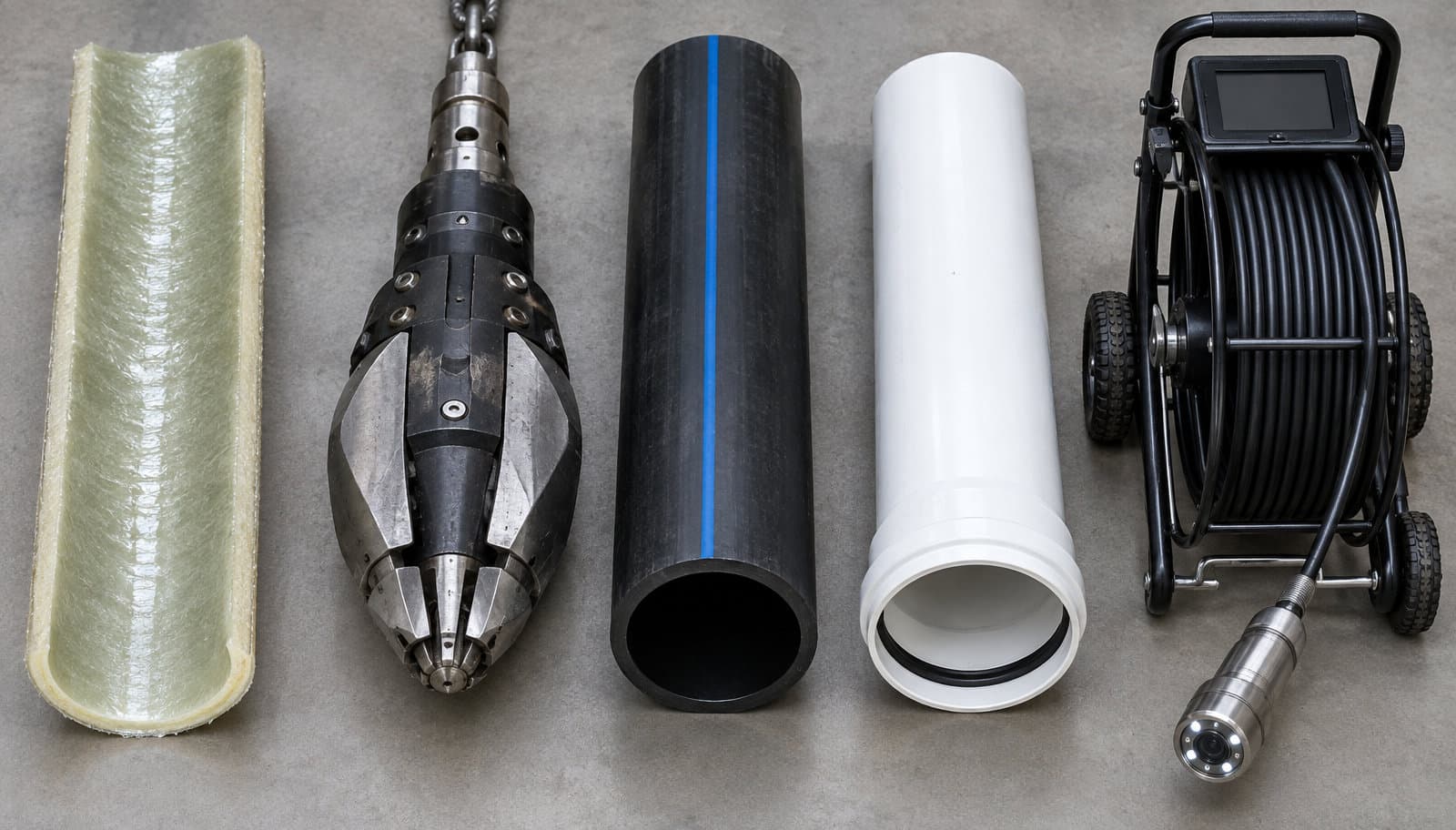
Successful trenchless repairs depend on sophisticated diagnostic and installation equipment. Pre-installation begins with camera inspection systems, followed by hydro jetting for pipe cleaning, and precision installation equipment.
Frequently Asked Questions
CIPP pipe lining is by far the most common trenchless repair method, accounting for approximately 60% of all trenchless rehabilitations in North America.
Modern trenchless repairs typically carry 50-year warranties and can last 50-100 years or more with proper installation.
Total project costs favor trenchless methods by 30-50% when including restoration expenses that traditional excavation requires.
Most pipes can be repaired using trenchless methods, but some limitations exist. A professional camera inspection determines which methods work for specific situations.
Conclusion: Choosing the Right Trenchless Method
The diverse array of trenchless repair methods available today ensures that nearly every pipe problem has an effective no-dig solution. Success begins with accurate diagnosis through professional camera inspection, continues with selecting the appropriate method for your specific pipe conditions, and concludes with proper installation by qualified contractors.
Ready to Find a Trenchless Contractor?
Connect with qualified trenchless contractors who can assess your specific situation and recommend the optimal solution.
Find Contractors Near You