

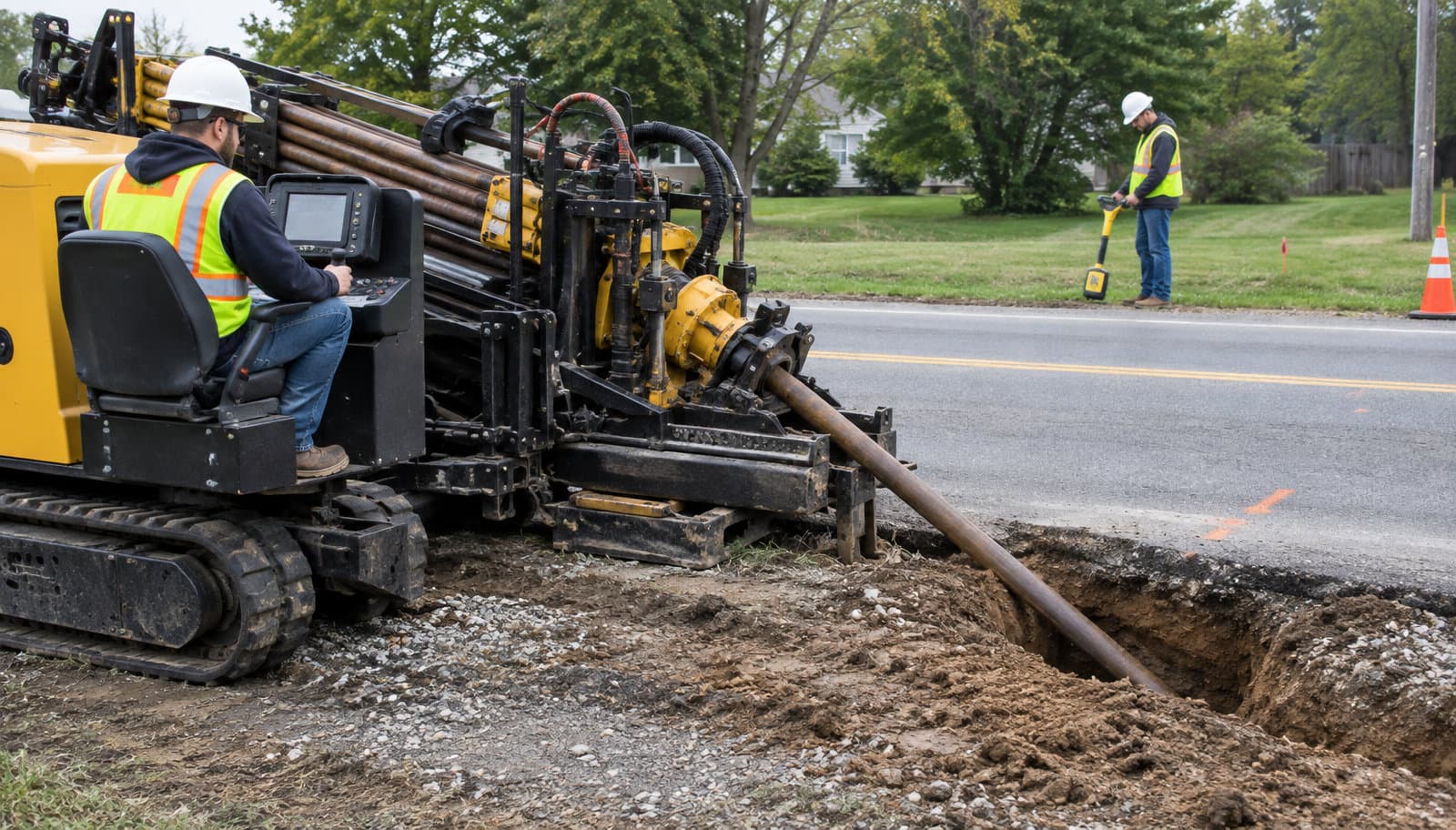
Horizontal Directional Drilling: HDD Installation Guide

🚜 Long-Distance Evolution
2,000-5,000+ feet capability • 24-48+ inch diameter • Scaled equipment power
Horizontal directional drilling—universally abbreviated as HDD—represents the scaled-up, long-distance evolution of basic directional drilling methods, employing larger drill rigs with substantially greater pulling forces enabling installations spanning thousands of feet and accommodating large-diameter pipes that smaller equipment cannot handle. Where compact directional drills install residential services and small municipal utilities across 200-500 foot distances, HDD rigs tackle major river crossings, interstate highway installations, and large-diameter transmission mains requiring 2,000-5,000+ foot bore lengths with 100,000-600,000+ pounds of pulling capacity.
The relationship to directional drilling fundamentals remains consistent—HDD follows the same three-phase process of pilot hole drilling with steerable heads, reaming to enlarge bores, and pulling pipes through completed holes. However, scale differences create distinct capabilities and applications. Maxi HDD rigs weighing 80,000-200,000+ pounds dwarf compact equipment at 5,000-15,000 pounds, with proportionally greater reach, pulling forces, and pipe diameter capabilities transforming what projects prove feasible.
Scale and capacity advantages position HDD as the go-to solution for major utility installations crossing significant obstacles or spanning substantial distances. A 3,000-foot river crossing installing 36-inch water transmission main lies far beyond compact directional drilling capabilities but represents routine HDD work. Highway corridor installations avoiding continuous pavement removal across miles of right-of-way favor HDD's long-distance capability.
Understanding HDD Technology
HDD installation follows the established three-phase directional drilling process—pilot hole drilling with steerable guidance, bore enlargement through reaming, and pipe pullback through the completed hole. The fundamental mechanics match compact directional drilling: drill heads with asymmetric faces steer through planned paths when rotation stops and thrust continues, while rotating drill strings advance straight. Electronic tracking systems monitor position, allowing operators to adjust steering maintaining design alignments.
Scale Differences Create Distinct Capabilities:
Compact directional drills generate 10,000-25,000 pounds pullback force suitable for 2-6 inch pipes across 200-500 feet. Midi HDD rigs produce 25,000-100,000 pounds handling 6-16 inch pipes over 500-1,500 feet. Maxi HDD equipment delivers 100,000-600,000+ pounds capable of pulling 24-48+ inch pipes through 2,000-5,000+ foot bores. These capacity increases enable installations impossible with smaller equipment—major infrastructure projects crossing rivers, highways, or spanning miles of corridor.
| Classification | Pullback Force | Pipe Diameter | Distance Range | Typical Applications |
|---|---|---|---|---|
| Mini/Compact HDD | 10,000-25,000 lbs | 2-6 inches | 200-500 feet | Residential services |
| Midi HDD | 25,000-100,000 lbs | 6-16 inches | 500-1,500 feet | Municipal utilities |
| Maxi HDD | 100,000-600,000+ lbs | 24-48+ inches | 2,000-5,000+ feet | Major infrastructure |
Midi HDD: The Municipal Workhorse
The 25,000-100,000 pound pullback category represents mainstream utility HDD—municipal water and sewer installations, gas distribution lines, telecommunications networks, and commercial/industrial utilities in 6-16 inch diameters. Mobilization costs of $15,000-40,000 and equipment versatility make midi HDD the default choice for standard utility installations requiring directional drilling capabilities.
Fundamental Trade-Off:
The fundamental trade-off between HDD and micro-tunneling involves accuracy versus distance and cost. HDD achieves ±12 inch horizontal accuracy adequate for protective casings, water/gas mains, conduit, and applications tolerating modest positional uncertainty. Micro-tunneling delivers ±0.5 inch laser-guided precision essential for gravity sewers requiring exact grades. This 24x accuracy difference creates distinct application niches.
Distance Capabilities:
Distance capabilities favor HDD substantially. Standard HDD installations span 500-2,000 feet routinely, with maxi equipment reaching 5,000+ feet for major projects. Micro-tunneling typically limits to 500-1,500 feet due to pipe jacking force accumulation. Long corridor installations or major obstacle crossings favor HDD's extended reach.
Cost Differences:
HDD costs $50-200 per foot depending on equipment size—substantially less than micro-tunneling's $200-600 range. However, projects demanding precise grades for gravity flow require micro-tunneling regardless of cost premiums. The selection depends on whether application requirements demand precision or accept HDD's adequate accuracy at lower costs.

Ideal HDD Applications
Distance Capability Benefits:
HDD's signature advantage involves distance capability—the technology routinely handles 500-2,000 foot installations with maxi equipment reaching 5,000+ feet for major projects. This extended reach eliminates intermediate access points that methods like micro-tunneling require for comparable distances, simplifying logistics and reducing costs.
River and Waterway Crossings:
River and waterway crossings benefit particularly from long-distance capability—single continuous bores span obstacles where traditional methods demand cofferdam construction or underwater work. Major highway crossings beneath interstates or urban arterials avoid the disruption, traffic control costs, and pavement restoration that surface methods require. The minimal access point requirement—entry and exit pits only—proves especially valuable where intermediate access proves difficult or impossible.
Pulling Capacity Scales with Equipment:
HDD's pulling capacity scales with equipment size, enabling large-diameter installations beyond compact directional drilling limits. Water transmission mains in 24-48+ inch diameters install via maxi HDD—the pulling forces handle substantial pipe strings across extended distances.
Application Types:
- Water transmission mains: 24-48+ inch diameters for municipal supply
- Gas distribution/transmission: Steel or HDPE pipes matching flow requirements
- Force main sewers: Pressure systems not requiring gravity grades
- Telecommunications/electrical: Fiber optic networks and power distribution

Drilling Fluid Systems
Bentonite Drilling Mud (Standard System):
Bentonite clay-based drilling mud represents the standard HDD fluid system—mixed with water to create slurry providing multiple critical functions. Bore hole stabilization prevents collapse in unstable soils through hydrostatic pressure and filter cake formation on bore walls. Cutting removal suspends excavated material for transport to surface separation equipment. Lubrication during pipe pullback reduces friction between pipe exterior and bore hole.
Polymer Systems (Alternative):
Synthetic polymer drilling fluids serve as alternatives to bentonite in sensitive environmental areas or where bentonite disposal proves problematic. Polymers provide bore hole stabilization through different mechanisms than bentonite, with various formulations suited to specific soil conditions.
Mud Management Critical:
Drilling fluid management proves critical to successful HDD installations and environmental compliance. Recycling systems separate solids from drilling mud at surface pits, allowing fluid reuse throughout installations. Environmental regulations increasingly restrict drilling fluid disposal, with inadvertent returns (drilling mud surfacing along bore paths) creating compliance issues requiring immediate remediation.
Advantages and Limitations
Major Advantages:
- Long distance capability: 2,000-5,000+ feet eliminates multiple access points
- Large diameter handling: Up to 48+ inches for transmission infrastructure
- Lower costs vs MT: $50-200/ft vs $200-600/ft when precision permits
- Established contractor base: Widely available equipment and expertise
- Versatile soil handling: Works in varied conditions from clays through gravels
- River crossing specialty: Signature application showcasing capability
- Environmental benefits: Minimal surface disruption, wetland protection
Important Limitations:
- ±12 inch accuracy limitation: Unsuitable for gravity sewers requiring precise grades
- Drilling fluid management: Adds complexity and environmental considerations
- Soil condition dependent: Large cobbles, boulders, hard rock challenge success
- Exit point accuracy: Final breakthrough location may vary several feet
- Not for gravity sewers: Grade control requires MT's ±0.5 inch precision
Costs & Applications
Cost Breakdown by Scale:
- Mini HDD: $50-100/ft for residential and small commercial work
- Midi HDD: $80-150/ft for municipal utilities (workhorse category)
- Maxi HDD: $100-200+/ft for standard work
- River crossings: $150-400/ft premium reflecting specialized complexity
Mobilization Costs:
Mobilization costs scale with equipment—$15,000-40,000 for midi rigs, $50,000-150,000+ for maxi equipment. For comprehensive trenchless cost comparisons, review our complete cost breakdown.
Frequently Asked Questions
Maxi HDD equipment routinely handles 3,000-5,000 foot installations, with exceptional projects reaching 8,000-10,000+ feet using specialized equipment and techniques. These extreme-distance installations typically involve major river crossings or offshore applications where alternative methods prove technically or economically infeasible. Standard HDD projects range 500-2,000 feet depending on equipment size and project requirements.
HDD generally proves unsuitable for gravity sewers requiring precise grades for proper flow. The ±12 inch accuracy means grades may deviate significantly from design values, creating low spots where solids settle or high spots restricting flow. Gravity systems demand micro-tunneling's ±0.5 inch precision maintaining exact grades. However, HDD works well for force main sewers—pressure systems not requiring gravity flow—where alignment flexibility exists.
HDD installations commonly reach 20-50 feet depth, with capabilities extending to 100-150+ feet for specialized applications. Maximum depth depends on equipment capacity, tracking system range, bore length, and ground conditions. Major river crossings often employ 30-60 foot depths ensuring adequate cover below anticipated scour depths.
Maxi HDD equipment handles pipes to 48-60+ inches in diameter given adequate pulling capacity and favorable ground conditions. Most large-diameter HDD work involves 24-42 inch pipes for water transmission mains, large force mains, or gas transmission lines. The practical diameter limit depends on available pulling force, bore length, soil conditions, and pipe material strength.
Neither technology proves universally superior—appropriate selection depends on project requirements. Choose HDD for: pressure systems (water mains, gas lines, force mains), applications accepting ±12 inch accuracy, long-distance installations (1,000+ feet), projects prioritizing lower costs ($50-200 vs $200-600/ft). Choose micro-tunneling for: gravity sewers requiring precise grades, tight clearances around existing utilities, applications demanding ±0.5 inch accuracy, projects where precision justifies premium costs.
Conclusion: HDD as Versatile Installation Solution
Horizontal directional drilling scales trenchless installation capability from residential service lines through major infrastructure projects spanning thousands of feet with large-diameter pipes. The technology's long-distance capability (2,000-5,000+ feet), large diameter handling (24-48+ inches), and lower costs versus precision methods ($50-200 vs $200-600/ft) establish HDD as the default choice for pressure system installations where ±12 inch accuracy suffices. From compact equipment serving residential markets through maxi rigs tackling major river crossings, HDD provides the versatile backbone of modern trenchless utility installation.
Understanding when HDD represents appropriate technology requires matching capabilities to requirements—long-distance pressure systems favor HDD, while grade-critical gravity applications demand micro-tunneling regardless of cost differences. For comprehensive guidance on trenchless installation methods, explore our complete technology comparisons.
Ready to Find HDD Contractors?
Connect with experienced horizontal directional drilling contractors for utility installations and major crossings.
Find HDD Specialists