
Micro-Tunneling Process: Precise Trenchless Installation
.png)
🎯 Extreme Precision Technology
±0.5-1 inch accuracy • 12-24x more precise than HDD • Laser-guided installation
Micro-tunneling represents the precision end of trenchless installation technology, using remote-controlled tunnel boring machines with laser guidance to achieve alignment accuracy impossible with methods like directional drilling. Where HDD achieves ±12 inch accuracy adequate for many applications, micro-tunneling delivers ±0.5-1 inch precision essential for gravity sewer systems, deep installations beneath critical infrastructure, or projects where even minor misalignment creates costly problems.
The precision versus cost trade-off defines when micro-tunneling makes sense. At $200-600 per linear foot—4-8 times more than directional drilling's $50-150 range—micro-tunneling demands justification through requirements that lower-precision methods cannot meet. Gravity sewers requiring exact grades for proper flow, installations beneath buildings where settlement must be minimized, deep tunnels navigating around existing utilities, or large-diameter pipes where alignment errors compound into major issues all favor micro-tunneling despite premium costs.
When accuracy justifies premium costs becomes clear through failure analysis and total project economics. A gravity sewer with improper grade creates perpetual operational problems—solids settling, recurring blockages, excessive maintenance—that can cost more over decades than the premium micro-tunneling commanded during installation. Deep installations beneath highways or buildings where directional drilling's larger positional uncertainty creates unacceptable risks make micro-tunneling the only viable option regardless of cost.
Understanding Micro-Tunneling Technology
Micro-tunneling creates precisely-aligned underground passages through a sophisticated process combining remote-controlled tunnel boring with continuous pipe installation. Unlike directional drilling where pipe installs after boring completes, micro-tunneling pushes pipe sections continuously behind the boring machine as excavation progresses.
Remote-Controlled Tunnel Boring Machine (MTBM):
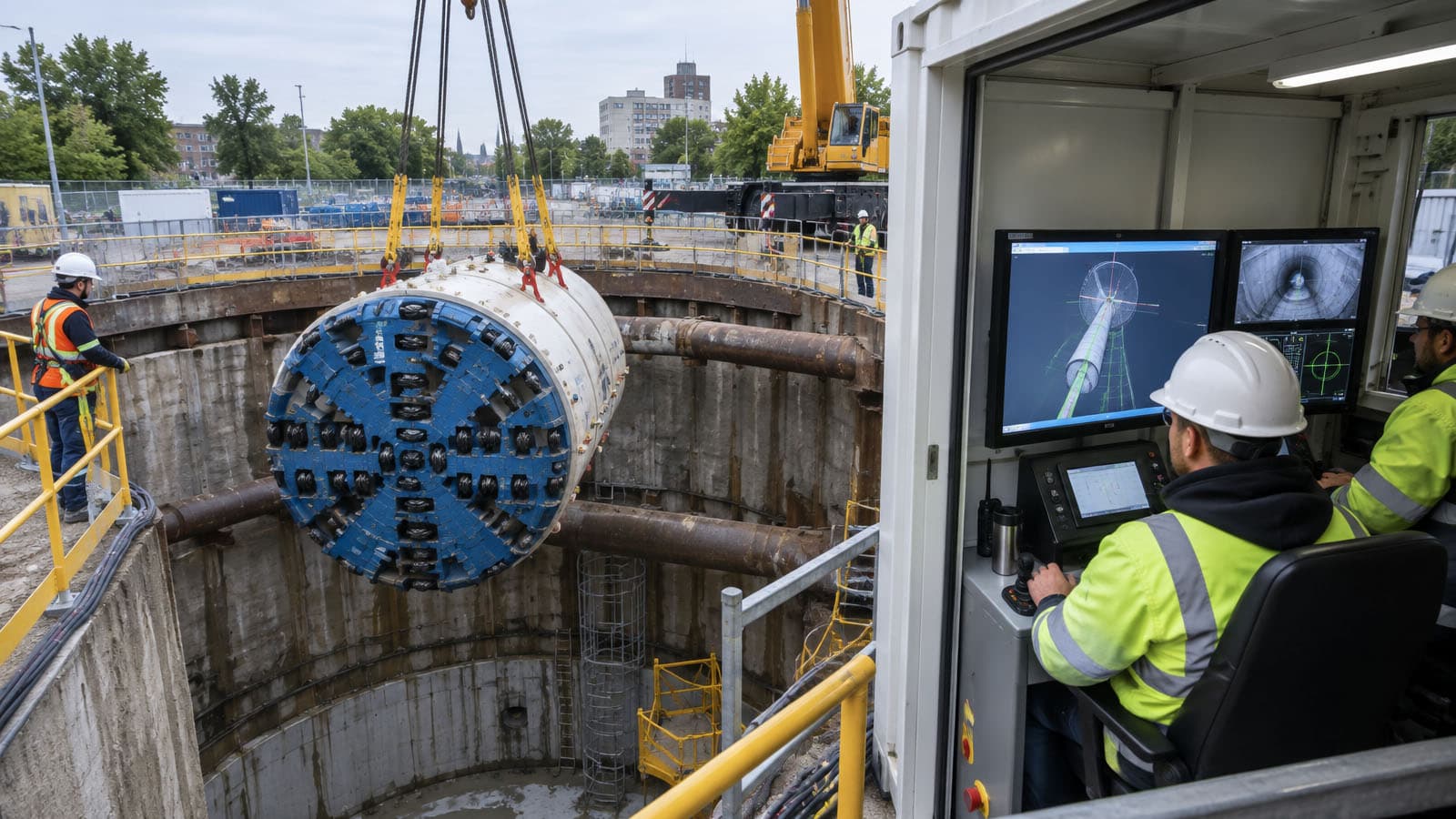
The remote-controlled tunnel boring machine operates from surface controls without requiring human entry into the tunnel. Operators monitor real-time position data, adjust steering parameters, and manage excavation rates from control stations, eliminating confined space entry risks while maintaining precise control. The cutting head at the tunnel face excavates material while steering systems maintain alignment with laser-established target lines.
Laser Guidance Systems:
Laser guidance systems provide the extraordinary precision defining micro-tunneling. A laser positioned in the entry shaft projects a reference beam through the tunnel to a target mounted on the MTBM. Sensors continuously measure the boring machine's position relative to this laser line, providing feedback allowing operators to maintain alignment within 0.5-1 inch over hundreds of feet. This closed-loop guidance system automatically corrects deviations, achieving accuracy impossible with directional drilling's electronic tracking.
Continuous Pipe Jacking:
Key Advantage: Continuous pipe jacking behind the boring head distinguishes micro-tunneling from directional drilling's drill-then-pull approach. Hydraulic jacks push pipe sections into the tunnel as excavation progresses, with each new section added at the entry shaft and jacked forward. This continuous installation eliminates bore hole stability concerns since pipe immediately supports excavated tunnel walls.
| Feature | Micro-Tunneling | Directional Drilling (HDD) |
|---|---|---|
| Alignment Accuracy | ±0.5-1 inch (laser-guided) | ±12 inches horizontal (electronic) |
| Precision Advantage | 12-24x more accurate | Baseline accuracy |
| Cost Per Foot | $200-600/ft | $50-150/ft |
| Entry/Exit Requirements | Large shafts (10x15 ft minimum) | Small pits (8x20 ft typical) |
| Shaft Cost | $50,000-200,000+ per shaft | $5,000-15,000 per pit |
| Installation Method | Continuous pipe jacking | Drill-then-pull approach |
| Advance Rate | 10-30 ft/day typical | 100-500 ft/day |
| Best Applications | Gravity sewers, deep installations | Pressure systems, longer runs |
| Ground Conditions | Excellent in difficult soils | Challenges in unstable ground |
⚠️ Cost vs Precision Trade-Off:
Micro-tunneling at $200-600 per foot suits precision-critical gravity sewers, deep installations beneath infrastructure, large-diameter pipes (18-72 inches), and unstable ground conditions. HDD at $50-150 per foot handles longer runs, flexible alignment requirements, smaller diameters, and applications where ±12 inch accuracy suffices. Neither technology is universally superior—appropriate selection depends on specific project requirements balancing precision, cost, and ground conditions.

The Micro-Tunneling Process
Micro-tunneling begins with substantial site preparation establishing the infrastructure supporting precision installation.
Entry Shaft Excavation:
Entry shaft excavation provides workspace for MTBM launch, pipe staging, hydraulic jacking frame installation, and support equipment. Shafts typically measure 10x15 feet minimum for small installations, expanding to 15x30 feet or larger for substantial projects. Proper shoring, dewatering if needed, and base slab installation create stable platforms for equipment setup and operation.
Laser Alignment Establishment:
Laser alignment establishment creates the reference line defining tunnel path. Survey-grade lasers mount in entry shafts, projecting beams through planned tunnel alignments to targets in exit shafts or intermediate shafts for long installations. Proper laser setup and verification prove critical—all subsequent boring references these initial alignments, so errors propagate throughout projects.
MTBM Setup:
MTBM setup and calibration involves positioning the boring machine in the entry shaft, connecting slurry or spoil removal systems, establishing hydraulic power for steering and excavation, and verifying guidance system operation. Pre-launch testing confirms all systems function properly and position sensors accurately track the laser reference line.
Once preparation completes, boring and pipe installation proceed simultaneously as integrated operations.
MTBM Cutting Head Operation:
The MTBM cutting head rotates while advancing into the tunnel face, excavating material through mechanical cutting or pressurized water jets depending on soil conditions. Operators monitor face pressure, advance rates, cutting torque, and guidance data, making real-time adjustments maintaining optimal excavation parameters. The laser guidance system continuously reports position, allowing steering corrections keeping the boring machine within specification tolerances.
Continuous Pipe Jacking:
Pipe jacking behind the MTBM occurs continuously as boring progresses. Each pipe section—typically 8-10 feet long for concrete pipes—is positioned in the entry shaft, aligned with the jacking frame, and pushed into the tunnel by hydraulic rams. The jacking force must overcome friction between pipe exterior and excavated soil, with lubrication systems injecting bentonite slurry around pipes reducing this friction. For longer installations, intermediate jacking stations distribute forces preventing pipe crushing from excessive loads.
Spoil Removal Systems:
The spoil removal system operates continuously throughout boring, with slurry circulation or auger conveyance transporting excavated material to surface processing. Slurry systems require separation plants where centrifuges or screens remove solids, allowing slurry reuse. Proper spoil management maintains face stability and prevents equipment overload.
Final operations include MTBM extraction from the exit shaft, position verification confirming as-built alignment matches specifications, connections to existing infrastructure at both ends, and restoration of entry/exit shafts once no longer needed. Quality documentation records final positions, grades, and any deviations from planned alignments.

Types of Micro-Tunneling Systems
Slurry Microtunneling (Most Common):
Slurry systems use pressurized bentonite or polymer slurry maintaining tunnel face stability while removing excavated material. The slurry circulates from surface pumps to the MTBM face, mixes with excavated soil, and returns via pipeline to surface separation equipment. This closed-loop system provides excellent face support in unstable soils, controls groundwater, and handles various soil conditions from soft clays to coarse gravels.
Auger Microtunneling:
Auger systems mechanically convey spoils through the MTBM via screw conveyors to surface discharge. Best suited for stable soils not requiring face support pressure, auger systems offer lower equipment complexity and reduced setup costs compared to slurry methods. The limitation to self-supporting soils restricts auger applications, but where conditions suit, cost advantages prove significant.
Earth Pressure Balance (EPB):
EPB systems maintain face stability through controlled pressure rather than slurry. A pressure bulkhead behind the cutting head, combined with screw conveyor discharge, balances face pressure against surrounding ground pressure. This approach suits unstable soils where auger systems would fail but where slurry handling proves undesirable. EPB systems are common in soft ground tunneling and urban installations where minimizing settlement proves critical.
Advantages and Limitations
Major Advantages:
- Extreme precision: ±0.5-1 inch alignment accuracy (12-24x better than HDD)
- Gravity sewer specialty: Grade control for proper sewer flow (0.5-2% maintained consistently)
- Difficult ground: Positive face control handles unstable soils that challenge HDD
- Minimal settlement: Critical for installations beneath structures
- Continuous installation: Complete systems without pull-back operations
- Deep capability: Feasible to 100+ feet where surface methods fail
- Large diameters: 18-72 inch range where alignment errors compound
- Tight clearances: Navigate around existing utilities with precision
Important Limitations:
- Highest cost: $200-600/ft (4-8x more than HDD's $50-150/ft)
- Shaft infrastructure: $50,000-200,000+ per shaft vs HDD's small pits
- Break-even >300-500 feet: Short runs prohibitively expensive
- Specialized equipment: Limited contractor availability
- Slow advance: 10-30 ft/day vs 100-500 ft/day for HDD
- Complex operations: Requires experienced operators and crews
The technology complexity demands experienced operators—this isn't DIY-friendly construction. The highest cost among trenchless methods limits micro-tunneling to applications justifying this premium through precision requirements that lower-cost methods cannot meet.
Ideal Applications
Perfect Micro-Tunneling Applications:
- Gravity sewers: Requiring precise grades (0.5-2%) for proper flow
- Deep installations: 20-100+ feet beneath surface
- Difficult soils: Soft clays, mixed face, high groundwater
- Urban navigation: Tight clearances around existing utilities
- Minimal settlement: Beneath buildings, railroads, highways
- Large diameters: 18-72 inches where alignment critical
Gravity sewers requiring precise grades represent micro-tunneling's primary market. The ±0.5-1 inch accuracy ensures proper flow velocities, prevents settling, and eliminates the operational problems improper grades create.
Concrete Pipe (Dominant Choice):
Concrete pipe dominates micro-tunneling applications due to strength withstanding jacking forces, availability in required sizes, and cost-effectiveness for large diameters.
Other Materials:
Steel casing pipes install for specific strength requirements or where pipe protection proves necessary. Fiberglass reinforced polymer (FRP) offers corrosion resistance for chemical applications. Ductile iron serves specialized needs. The pipe selection balances jacking load capacity, service requirements, and project economics.
Costs & Pricing
Micro-tunneling typically costs $200-600 per linear foot for installation—4-8 times more than directional drilling. This premium reflects sophisticated equipment, specialized crews, and shaft infrastructure.
Fixed Cost Impact:
Entry/exit shafts add $50,000-200,000+ per shaft depending on depth, size, and ground conditions. These substantial fixed costs mean project length critically impacts per-foot economics—a 200-foot installation might cost $500/ft total, while 1,000 feet could average $250/ft as fixed costs distribute across more production footage.
Break-Even Analysis:
Break-even analysis typically shows micro-tunneling economical only for runs exceeding 300-500 feet unless precision requirements leave no alternatives. For shorter installations requiring extreme accuracy, micro-tunneling may prove necessary despite poor economics. For comprehensive trenchless cost comparisons, review our complete cost breakdown.
Frequently Asked Questions
Micro-tunneling achieves ±0.5-1 inch alignment accuracy through laser guidance systems—roughly 12-24 times more precise than directional drilling's ±12 inch horizontal accuracy. This extreme precision enables gravity sewer installations meeting exact grade requirements and installations navigating tightly around existing utilities where larger positioning errors would create interference or damage risks.
Micro-tunneling uses laser-guided boring machines with continuous pipe jacking achieving ±0.5-1 inch accuracy at $200-600/ft. HDD uses steerable drill heads with electronic tracking achieving ±12 inch accuracy at $50-150/ft. Micro-tunneling suits precision-critical gravity sewers and tight clearances. HDD handles flexible alignment requirements and longer runs. Neither is universally superior—select based on precision requirements versus cost constraints.
Yes, specialized MTBM cutting heads handle rock formations. Rock microtunneling typically uses disc cutters or impact hammers breaking rock as the machine advances. Rock boring costs more than soft ground ($400-800+/ft typical) due to slower advance rates, increased wear, and specialized equipment. However, micro-tunneling handles rock more effectively than HDD, which struggles in hard formations.
High costs reflect sophisticated equipment (MTBMs cost $500,000-2,000,000+), specialized crews requiring extensive training, substantial shaft infrastructure ($50,000-200,000+ per shaft), slower advance rates than HDD (10-30 ft/day typical vs 100-500 ft/day for HDD), and complex support systems for slurry handling or spoil removal. The precision capability justifies costs only when accuracy proves critical to project success.
Micro-tunneling typically installs pipes 12-72 inches in diameter. Smaller diameters prove uneconomical due to fixed mobilization costs, while larger diameters transition into conventional tunneling territory. The 18-48 inch range represents the sweet spot where micro-tunneling economics and capabilities align optimally with typical utility infrastructure needs.
Conclusion: Micro-Tunneling as Precision Solution
Micro-tunneling occupies the precision niche within trenchless installation technology, delivering alignment accuracy impossible with directional drilling but at 4-8x the cost. This extreme precision—±0.5-1 inch versus HDD's ±12 inches—justifies premium costs only when accuracy proves critical: gravity sewers demanding exact grades, deep installations beneath infrastructure, or urban projects navigating tightly around existing utilities.
Understanding when extreme accuracy justifies premium costs requires honest assessment of consequences that misalignment creates versus incremental project costs. Gravity sewers with improper grades generate perpetual operational problems potentially costing more over decades than micro-tunneling premiums. Projects where HDD's ±12 inch uncertainty creates unacceptable risks make micro-tunneling the only viable option. However, applications tolerating flexible alignment benefit from HDD's lower costs and faster installation. For additional guidance on trenchless methods, explore our comprehensive technology comparisons.
Ready to Find Micro-Tunneling Specialists?
Connect with experienced micro-tunneling contractors for precision-critical gravity sewer and infrastructure installations.
Find Specialists