

Pipe Bursting Method: Complete Installation Guide 2025
.jpeg)
When underground pipes deteriorate beyond repair—through severe corrosion, complete collapse, or structural damage too extensive for rehabilitation—property owners need complete pipe replacement. Traditional excavation means digging trenches the entire length of the damaged pipe, destroying landscapes and infrastructure along the way. Pipe bursting offers a revolutionary alternative: replacing underground pipes with minimal surface disruption.
Pipe bursting is a trenchless pipe replacement method that breaks apart existing damaged pipes while simultaneously pulling new pipes into place underground. Unlike rehabilitation techniques such as CIPP pipe lining that create liners within existing pipes, pipe bursting completely replaces the old pipe with a new one—often with increased diameter for improved flow capacity.
This innovative technology has transformed how contractors approach severely damaged sewer and water lines, particularly collapsed sewer lines that cannot be rehabilitated. This comprehensive guide explains how pipe bursting works, when it's the best solution, what the process costs, and how it compares to alternative methods.
How Pipe Bursting Works
Pipe bursting follows a systematic three-phase process that breaks the old pipe and installs the new pipe in a single continuous operation. This coordinated approach minimizes installation time while ensuring precise pipe placement.
Phase 1: Preparation & Setup
Every pipe bursting project begins with thorough assessment and preparation. Contractors perform camera inspection to document pipe condition, identify damage locations, and verify pipe diameter and alignment. This diagnostic step confirms that pipe bursting is the appropriate solution and helps plan equipment requirements.
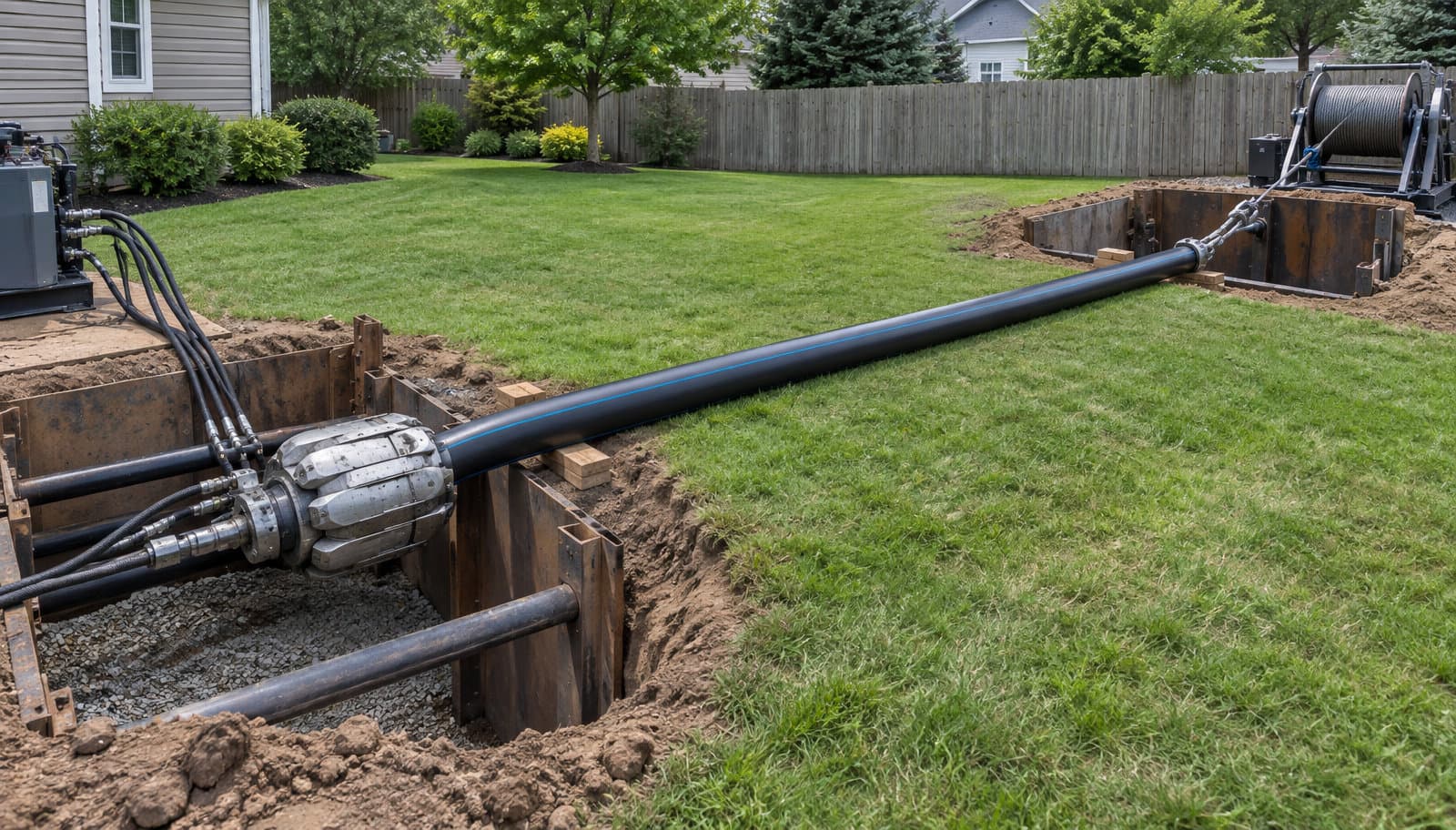
Once assessment is complete, crews excavate small access pits at the pipe's entry and exit points. These pits typically measure 4 feet by 4 feet and provide space for equipment setup and pipe connections. The entry pit houses the pulling system that draws the bursting head and new pipe through the ground, while the exit pit allows the bursting head to emerge after breaking through the old pipe.
Phase 2: Bursting the Old Pipe
The pipe bursting operation centers on a specialized bursting head—a cone-shaped device that fractures and displaces the existing pipe as it's pulled through. The bursting head's expanding diameter first cracks the old pipe, then pushes fragments outward into the surrounding soil. This displacement creates space for the new pipe while the old pipe material remains underground, compacted into the surrounding soil.
Hydraulic or pneumatic pulling systems provide the tremendous force needed—often 100,000+ pounds—to pull the bursting head through the damaged pipe. The pulling system in the entry pit draws the bursting head from the exit pit, breaking the old pipe incrementally as it advances. Modern equipment includes real-time monitoring that tracks pulling force, advancement speed, and equipment position, allowing operators to adjust parameters for optimal performance.
Phase 3: New Pipe Installation
The genius of pipe bursting lies in its simultaneous destruction and replacement process. Attached directly behind the bursting head, the new replacement pipe—typically HDPE pipe—follows immediately as the bursting head advances. The pulling force that breaks the old pipe also pulls the new pipe into position, installing it in the cavity created by the displaced old pipe fragments.
Once the bursting head emerges from the entry pit with the new pipe trailing behind it, crews disconnect the equipment, connect the new pipe to existing plumbing systems, and backfill the small access pits. The entire underground pipe has been replaced with minimal surface disruption.

Pipe bursting equipment has evolved significantly since the technology's introduction in the 1980s. Modern systems combine powerful hydraulics, sophisticated controls, and real-time monitoring to ensure successful installations even in challenging conditions.
Bursting Heads
The bursting head represents the core technology. These cone-shaped devices feature hardened steel construction with precisely calculated expansion angles that balance fracturing force against soil displacement. Interchangeable heads accommodate different pipe diameters and allow upsizing by selecting heads with larger final diameters than the original pipe.
Pulling Systems
Pulling systems vary in capacity from smaller residential units generating 30,000-50,000 pounds of force to massive municipal equipment capable of 200,000+ pounds. Hydraulic winch systems offer precise speed control and constant force, while pneumatic systems add impact assistance for harder pipe materials. The pulling system selection depends on pipe diameter, material, length, and soil conditions.
Pneumatic Pipe Bursting
Pneumatic pipe bursting combines pulling force with percussive impact to break through particularly tough pipe materials. A pneumatic hammer mounted within or behind the bursting head delivers rapid impacts—typically 400-600 blows per minute—that help fracture brittle pipes like clay and cast iron. The combination of steady pulling and impact force proves especially effective in hard soils or when bursting thick-walled pipes.
Hydraulic Pipe Bursting
Hydraulic pipe bursting applies continuous, controlled pulling force without impact. Powerful hydraulic winches pull the bursting head steadily through the old pipe, relying on the head's expansion force to fracture the pipe. This method produces less vibration than pneumatic bursting and offers precise control over advancement speed. Hydraulic systems excel in stable soil conditions with moderately damaged host pipes.
Static Pipe Bursting
Static pipe bursting relies entirely on the bursting head's expansion force to fracture and displace the old pipe, with no pulling assistance from hydraulics or pneumatics. This method generates no vibration whatsoever, making it the quietest and least disruptive pipe bursting approach. Static bursting proves ideal near sensitive structures where vibration must be minimized.
When to Choose Pipe Bursting
Pipe bursting becomes the method of choice in specific situations where complete pipe replacement is necessary or where its unique capabilities provide clear advantages over alternative trenchless methods.
Choose Pipe Bursting When:
- Pipes are severely damaged or collapsed: When structural integrity is compromised beyond rehabilitation
- Increased capacity is needed: Upsizing from 4" to 6" or 6" to 8" for better flow
- Complete replacement provides better value: Long-term solution for aged infrastructure
- Host pipe material isn't suitable for lining: Orangeburg, severely corroded cast iron
- Pipes have significant misalignment or bellying: Structural issues that lining cannot correct
Pipe Diameter Capabilities
Pipe bursting technology accommodates a wide range of pipe sizes, from small residential sewer laterals to large municipal trunk lines. Residential applications typically involve 4-8 inch diameter pipes, while commercial and municipal projects may burst pipes up to 48 inches or larger with specialized equipment.
Upsizing Capabilities
One of pipe bursting's most valuable features is the ability to increase pipe diameter during replacement. One-size increases (4" to 6", 6" to 8") are standard practice with conventional equipment. Two-size increases become possible with specialized large-expansion bursting heads and favorable soil conditions, though this requires significantly more pulling force.
Fundamental Differences
Understanding the fundamental differences between pipe bursting and CIPP lining helps property owners and contractors select the optimal method. Pipe bursting completely replaces the old pipe with a new one, while CIPP creates a new liner within the existing pipe structure. This core difference drives all other distinctions between the methods.
| Feature | Pipe Bursting | CIPP Lining |
|---|---|---|
| Approach | Complete replacement | Rehabilitation/lining |
| Host Pipe Required | No - destroys old pipe | Yes - needs 60%+ integrity |
| Diameter Change | Can upsize 1-2 sizes | Reduces by liner thickness |
| Severely Damaged Pipes | Handles any condition | Requires structural integrity |
| Installation Time | 1-2 days typical | Same-day possible |
| Cost Range | $60-200 per foot | $80-250 per foot |
When CIPP is Better
Conversely, many situations favor CIPP lining over pipe bursting. CIPP works better when the existing pipe retains adequate structural integrity (60%+ remaining), when preserving existing diameter is acceptable, for faster same-day service restoration, and when dealing with pipes that have bends or curves that would complicate pipe bursting.
Materials & Pipe Options
HDPE Pipe Properties
High-density polyethylene (HDPE) pipe has become the standard replacement pipe for pipe bursting applications, offering an exceptional combination of strength, flexibility, and longevity that makes it ideal for underground installation.
Key HDPE Advantages:
- Flexibility: Accommodates ground movement and settling without cracking
- Joint-free installation: Fusion-welded sections create continuous pipe with no weak points
- Corrosion resistance: Immune to chemical attack, electrolysis, or rust
- Smooth interior: Low friction coefficient improves flow characteristics
- Longevity: 100+ year expected service life under normal conditions
- Lightweight: Easier handling and lower pulling forces required
Alternative Replacement Pipe Materials
While HDPE dominates pipe bursting applications, certain situations may warrant alternative pipe materials. PVC pipe offers cost advantages for some applications, though it lacks HDPE's flexibility. Ductile iron pipe provides maximum strength for high-pressure applications or locations requiring extreme crush resistance. Specialized composite pipes combine different materials to achieve specific performance characteristics.

Pipe Bursting Costs
Cost Range & Factors
Pipe bursting costs typically range from $60-200 per linear foot depending on multiple factors that influence project complexity and equipment requirements. Understanding these cost drivers helps property owners budget accurately and evaluate contractor proposals.
Key cost factors include: Pipe diameter (larger pipes require more force and specialized equipment), pipe material being replaced (harder materials increase difficulty), soil conditions (rocky or unstable soils complicate installation), access difficulty (restricted access requires specialized equipment), pipe depth (deeper pipes increase excavation and equipment costs), and project length (longer runs offer better per-foot economics).
Cost Comparison vs Other Methods
Understanding pipe bursting costs relative to alternative solutions helps property owners make informed decisions. When accounting for all project costs including restoration, pipe bursting typically costs 20-40% less than traditional excavation. Compared to CIPP lining, pipe bursting may cost slightly less upfront, though both methods offer similar total project costs when pipes are suitable for either approach.
Hidden Cost Advantages:
- No landscape restoration expenses ($2,000-8,000 savings)
- No driveway/hardscape replacement ($3,000-15,000 savings)
- Faster completion reduces labor costs
- Minimal business disruption for commercial properties
- Lower long-term maintenance costs with HDPE pipe
Advantages & Limitations
Major Benefits:
- Complete pipe replacement: New pipe from end to end, not a patch or liner
- Handles any pipe condition: Works with collapsed, severely damaged, or deteriorated pipes
- Upsizing capability: Increase diameter for improved flow capacity
- Minimal surface disruption: Small access pits instead of continuous trenching
- Long service life: HDPE pipe provides 100+ year lifespan
- Fast installation: Most projects complete in 1-2 days
- Cost-effective: Lower total project costs than excavation
While pipe bursting offers numerous advantages, understanding its limitations helps set realistic expectations. The method requires adequate pulling force and working space at access points. Extremely rocky soils or highly unstable ground may complicate installation. Pipes with very tight bends may limit equipment passage. Properties with limited access for equipment delivery may face challenges or increased costs.
Site Preparation Requirements
Successful pipe bursting installations require adequate preparation. Access pits need sufficient space for equipment setup—typically 4'x4' minimum. The site must accommodate equipment delivery and positioning. Underground utility locations must be verified to avoid conflicts. Surface conditions should allow safe excavation and support heavy equipment if needed.
Installation Timeline
Pipe bursting projects typically complete faster than traditional excavation methods. Residential installations usually finish in 1-2 days from equipment setup through final connection. This timeline includes initial assessment, pit excavation, pipe bursting operation, new pipe connection, and pit backfilling.
Commercial or municipal projects may take several days to a week depending on length and complexity. Longer pipe runs, larger diameters, or challenging site conditions extend installation time. However, even complex pipe bursting projects complete 50-70% faster than equivalent excavation-based replacements.
Frequently Asked Questions
Pipe bursting works in most soil types, though equipment and technique selection vary by conditions. Clay, sand, and mixed soils present few challenges. Rocky soils may require more powerful equipment or specialized bursting heads. Very loose or unstable soils may need additional support measures. Contractors assess soil conditions during project planning to select appropriate equipment.
Pipe bursting minimizes landscape damage compared to traditional excavation. Only small access pits (typically 4'x4') disturb the surface. Mature trees, gardens, driveways, and hardscaping remain undisturbed except at pit locations. After installation, contractors backfill and restore the small pit areas, leaving the vast majority of the property untouched.
Pipe bursting accommodates gentle bends and curves effectively, especially with flexible HDPE replacement pipe. Standard equipment handles bends up to 20-30 degrees. Sharper bends may require additional access points or specialized techniques. During assessment, contractors identify bend locations and plan accordingly.
The old pipe fragments remain in the ground, displaced into the surrounding soil around the new pipe. The bursting head pushes fractured pieces outward, compacting them into the soil or filling voids in the existing pipe zone. This displacement creates the cavity for the new pipe while eliminating the need for pipe removal and disposal.
Yes, pipe upsizing represents one of pipe bursting's key advantages. One-size increases (4" to 6", 6" to 8") are standard practice with conventional equipment. Two-size increases become possible with specialized large-expansion bursting heads and favorable soil conditions, though this requires significantly more pulling force.
HDPE pipe installed through pipe bursting provides exceptional longevity. Industry data and accelerated aging tests indicate 100+ year service life under normal conditions. The pipe's corrosion resistance, flexibility, and joint-free construction eliminate the common failure modes that affect traditional pipe materials.
Conclusion: Choosing Pipe Bursting for Your Project
Pipe bursting represents a powerful solution for replacing underground pipes that have deteriorated beyond rehabilitation. Its ability to handle pipes in any condition—from moderately damaged to completely collapsed—while simultaneously offering upsizing capabilities makes it uniquely valuable for infrastructure replacement projects.
The method's combination of complete pipe replacement, minimal surface disruption, fast installation, and cost-effectiveness has made it a preferred choice for residential, commercial, and municipal applications. When pipes need replacing rather than rehabilitation, pipe bursting delivers long-lasting results with significantly less property impact than traditional excavation.
Success with pipe bursting begins with professional assessment to confirm the method suits your specific situation, followed by selection of experienced contractors with appropriate equipment and expertise. The investment in pipe bursting delivers decades of reliable service from new HDPE pipe while preserving your property's surface features.
Ready to Find a Pipe Bursting Contractor?
Connect with experienced pipe bursting contractors who can assess your specific situation and provide detailed proposals for your pipe replacement project.
Find Qualified Contractors