

Slip Lining Process: Simple Pipe-in-Pipe Installation

80+ Years of Proven Performance
The Original Trenchless Method • 1940s to Present
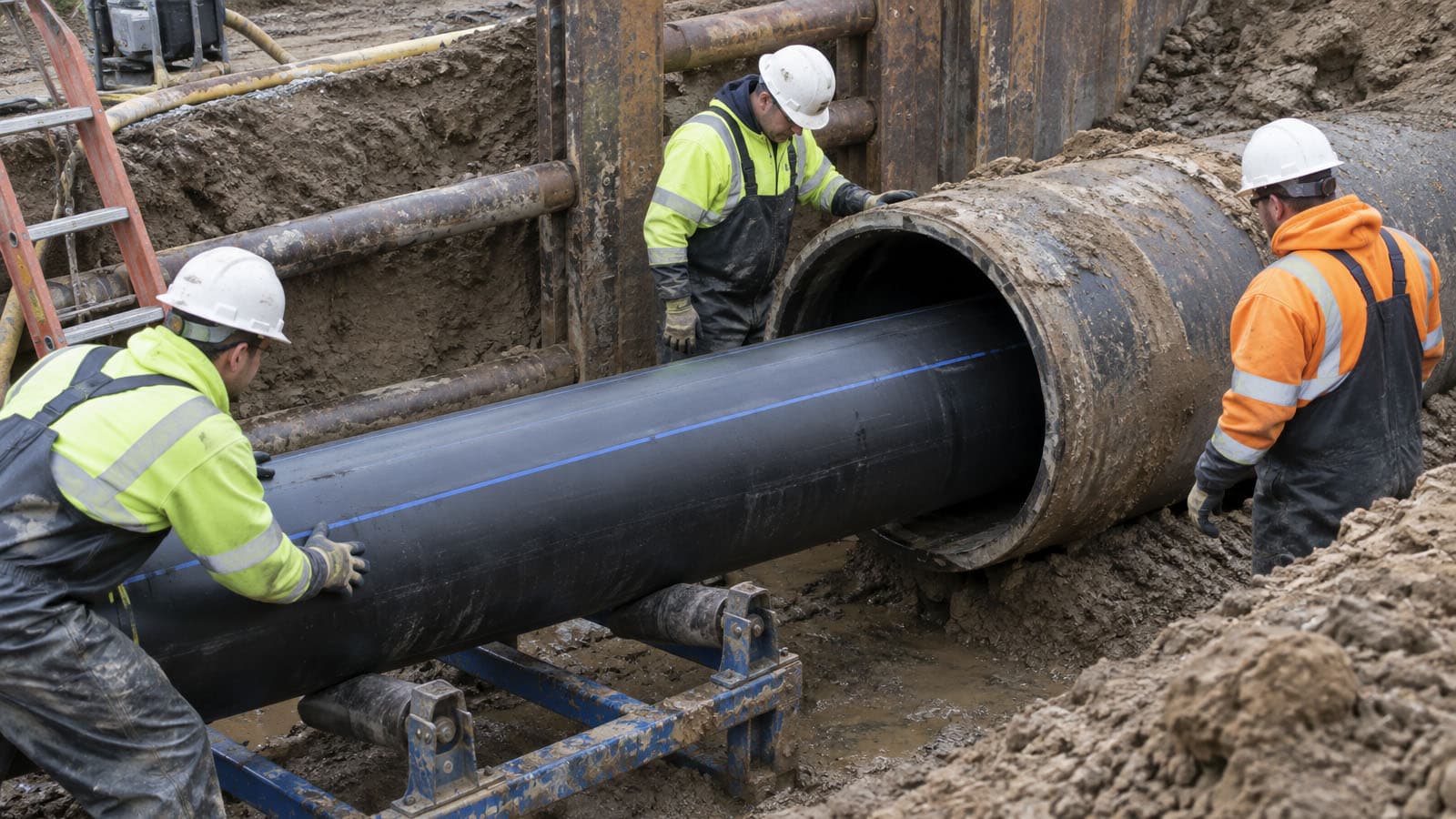
Slip lining represents one of the oldest trenchless repair methods, predating modern CIPP pipe lining technology by decades. The concept couldn't be simpler: insert a new, smaller-diameter pipe inside an existing damaged pipe, effectively creating a pipe-within-a-pipe configuration. This straightforward mechanical approach requires no chemical curing, no specialized resin systems, and no complex equipment—just basic pulling machinery and proper planning.
First developed in the 1940s as utilities sought alternatives to complete pipe replacement, slip lining gained widespread adoption through the 1960s-1980s before newer trenchless technologies emerged. Despite being the grandfather of trenchless methods, slip lining remains relevant today for specific applications where its unique characteristics—simplicity, immediate functionality, and lower equipment costs—outweigh the diameter reduction it inevitably causes.
The enduring appeal of slip lining stems from its mechanical simplicity and proven track record. With 80+ years of field performance, slip lining's long-term reliability is thoroughly documented. The method works with various host pipe materials, requires no curing downtime, and provides immediate service restoration once installation completes. For large-diameter gravity sewers, water mains, and situations where 10-20% diameter reduction proves acceptable, slip lining often delivers the most cost-effective rehabilitation solution.
Understanding Slip Lining Technology
The slip lining concept embodies mechanical simplicity: insert a new pipe of slightly smaller diameter into an existing damaged pipe, creating a rehabilitated system where the new pipe carries flow while the old pipe serves as permanent protective casing.
The Insertion Process:
The insertion process uses pull ropes or cables to draw new pipe sections through host pipes from entry to exit points. For long runs, multiple pipe sections are joined during insertion, either through welding, heat fusion, or mechanical couplings depending on pipe material. The pulling force must overcome friction between the new pipe's exterior and the host pipe's interior, requiring calculations to ensure adequate pulling capacity without damaging either pipe.
Carrier Pipe Function:
Once positioned, the carrier pipe (old pipe) becomes a permanent protective casing, shielding the new liner pipe from external loads and ground conditions. The annular space—the gap between liner and host pipe—requires filling with grout to transfer loads, prevent liner movement, and eliminate voids where infiltration could occur.
Critical Success Factor:
Annular Space Grouting: This grouting step proves critical to long-term performance, ensuring the host pipe and new liner function as an integrated system rather than two independent pipes. The grout transfers external loads, prevents flotation, and creates structural continuity throughout the installation.
| Feature | Slip Lining | CIPP | Pipe Bursting |
|---|---|---|---|
| Diameter Reduction | 10-20% (significant) | 3-6% (minimal) | None (can increase) |
| Curing Required | No - immediate use | Yes - 3-6 hours | No - mechanical |
| Equipment Cost | Low (basic winches) | Medium (curing systems) | High (bursting heads) |
| Technology Age | 80+ years (1940s) | 50 years (1970s) | 40 years (1980s) |
| Complexity | Simple mechanical | Moderate (resin systems) | Complex (bursting forces) |
| Best Applications | Large gravity sewers (36"+) | All diameters 4-72" | Replacement needed |
| Cost Range | $75-200/ft | $80-250/ft | $100-300/ft |
The key trade-offs involve diameter reduction versus complexity and cost. Slip lining sacrifices 10-20% of interior diameter but offers simpler logistics and lower equipment costs. CIPP reduces diameter only 3-6% but requires specialized curing equipment and trained technicians. Pipe bursting maintains or increases diameter but demands highest equipment investment and pulling forces.

Types of Slip Lining Methods
Continuous Slip Lining:
The continuous approach involves pulling or pushing a single, long section of new pipe through the host pipe in one operation. Long pipe strings are assembled above ground or at the entry point, then inserted as a continuous unit. This method works best for straight or gently curved alignments with adequate working space for pipe handling.
Advantages: Faster installation for suitable applications, fewer joints means fewer potential leak points, simpler logistics for standard projects, lower labor costs per linear foot
Segmental Slip Lining:
Segmental installation inserts shorter pipe sections sequentially, joining them inside the host pipe as installation progresses. Individual sections, typically 10-20 feet long, are pushed or pulled into position sequentially. Workers connect sections using mechanical couplings, push-fit joints, or fusion techniques adapted to confined spaces.
Advantages: Works in situations where continuous methods can't access, requires less working space at entry points, navigates tighter curves and complex alignments, provides more flexibility for challenging projects
Spiral Wound Slip Lining:
A specialized variation creates new pipe by spirally winding a continuous steel or PVC strip inside the host pipe, forming a structural tube through progressive profile interlocking. The winding machine advances through the host pipe, continuously forming new liner pipe from coiled strip material fed from above ground. Each revolution locks into the previous wrap, creating a strong helical seam that provides structural integrity.
Fold-and-Form Methods:
These innovative approaches temporarily deform pipe to smaller cross-sections for insertion, then restore original shape once positioned. Various proprietary systems exist using different forming mechanisms. The diameter advantage proves significant—deformed pipes occupy less space during insertion, reducing or eliminating the typical slip lining diameter penalty. However, the specialized equipment, higher material costs, and limited contractor availability restrict these methods to specific applications.
The Slip Lining Installation Process
Phase 1: Host Pipe Preparation
Successful slip lining begins with thorough host pipe preparation ensuring the carrier pipe can receive the new liner without installation complications. High-pressure cleaning removes debris, scale, and protruding obstructions. Internal obstacles—roots, collapsed sections, severe deformations—require removal or correction. The host pipe interior must provide clear passage for liner insertion.
Phase 2: Access Point Creation
Slip lining requires entry and exit points for liner insertion, typically created through limited excavation at pipe terminations rather than continuous trenching. Entry pits must accommodate pipe handling equipment and provide adequate working room. Exit pits receive the liner and house pulling equipment. The minimal excavation—typically two small pits rather than continuous trenching—represents a major slip lining advantage.
Phase 3: Liner Pipe Insertion
The actual insertion process draws the new liner pipe through the host pipe using mechanical pulling equipment. Pull rope or cable installation through the host pipe provides the connection between pulling equipment and liner. Hydraulic winches or pulling rigs draw the liner through at controlled speeds. Pulling force calculations ensure adequate capacity while preventing pipe damage.
Phase 4: Positioning and Connection
Once the liner reaches its final position, crews secure it against movement and establish connections. End seals at entry and exit points prevent infiltration and fix the liner position. Connections to existing infrastructure—upstream and downstream pipes, structures, chambers—require waterproof sealing. Service connections through the host pipe wall need reopening and reconnection to the new liner.
Phase 5: Annular Space Treatment
Filling the annular space between liner and host pipe completes the installation, creating an integrated system. Grout injection proves critical—it transfers external loads from host pipe to liner, prevents liner flotation or movement, eliminates voids where infiltration could accumulate, and creates thermal and structural continuity. Injection procedures typically begin at low points, progressively filling upward to prevent air entrapment.

Benefits & Limitations
Major Advantages:
- Mechanical simplicity: No chemical curing, no specialized resin systems, basic equipment
- Immediate functionality: Service restoration once installation completes - no waiting
- 80+ year track record: Thoroughly proven long-term reliability and performance
- Lower equipment costs: Basic winches vs specialized CIPP or bursting equipment
- Works with any host material: Concrete, clay, cast iron, PVC - all compatible
- No weather concerns: Mechanical process unaffected by temperature
- Large diameter ideal: Economics improve significantly for 36-72 inch pipes
- Permanent carrier protection: Host pipe shields new liner from external loads
Optimal Applications:
Slip lining excels for large-diameter gravity sewers (36+ inches), oversized pipes accepting diameter reduction, cost-sensitive rehabilitations, situations valuing mechanical simplicity, projects requiring immediate service restoration, and installations where proven 80-year technology matters more than cutting-edge innovation.
Capacity Impact Analysis:
The most significant slip lining limitation involves inevitable diameter reduction as smaller pipes fit inside existing pipes. Typical reductions of 10-20% significantly impact flow capacity—a 12-inch host pipe receiving a 10-inch liner loses 30% of flow area despite only 17% diameter reduction (flow area varies with diameter squared).
Example Diameter Reductions:
- 12-inch → 10-inch: 17% diameter loss, 30% capacity reduction
- 24-inch → 20-inch: 17% diameter loss, 30% capacity reduction
- 36-inch → 30-inch: 17% diameter loss, 30% capacity reduction
- 48-inch → 40-inch: 17% diameter loss, 30% capacity reduction
When Diameter Loss is Problematic:
- Pipes already at capacity: Any reduction creates flow problems
- Small diameter pipes: Under 24 inches, percentage loss matters more
- Pumped systems: Reduced diameter increases pumping costs
- High-flow applications: Industrial or large commercial facilities
Access Point Requirements:
Slip lining requires entry and exit points for liner insertion, necessitating excavation at both ends despite being "trenchless." While far less disruptive than full-length trenching, these access pits still require surface disruption, traffic management, and restoration. The two-point access requirement limits slip lining for pipes without suitable insertion locations.
Host Pipe Condition Requirements:
Severely collapsed, heavily offset, or substantially deformed host pipes prevent liner passage. While slip lining tolerates moderate host pipe deterioration, complete collapse or major deformation requires excavation and traditional replacement. Internal obstructions exceeding clearances between host pipe and new liner must be removed before insertion.
Alignment Limitations:
Sharp bends, severe direction changes, or complex pipe paths complicate or prevent continuous slip lining. While segmental methods handle curves better, extremely tortuous alignments may prove impractical. Pre-installation assessment determines if pipe geometry permits successful liner insertion.
Slip Lining Costs
Typical Cost Range:
Slip lining typically costs $75-200 per linear foot depending on diameter, access difficulty, project length, and liner material selection. This positions slip lining competitively with or slightly below CIPP for large-diameter applications while offering simpler logistics and immediate functionality.
Cost Factors:
- Pipe diameter: Larger diameters require more material but offer better economies
- Liner material: HDPE, PVC, PE—each with different price points
- Project length: Longer runs dilute mobilization costs per foot
- Access difficulty: Deep installations or challenging locations increase costs
- Grouting requirements: Large annular spaces require more grout material
- Connection complexity: Multiple service connections add labor
Cost Comparison with Alternatives:
For large-diameter pipes (36+ inches), slip lining often proves most economical. The straightforward mechanical process, lower equipment costs, and immediate functionality translate to competitive pricing despite diameter reduction. Full pipe replacement costs $200-400/ft including excavation, making slip lining 40-60% less expensive for suitable applications.
Frequently Asked Questions
Typical diameter reduction ranges from 10-20% depending on host pipe size and new liner selection. For example, a 36-inch host pipe typically receives a 30-inch liner (6-inch or 17% reduction), while a 48-inch pipe might receive a 40-inch liner (8-inch or 17% reduction). The flow capacity impact proves more severe than diameter reduction suggests—losing 17% diameter typically reduces flow area by 30% since area varies with diameter squared. This capacity loss must be carefully evaluated against existing and future flow requirements.
Yes, but with limitations based on bend radius and liner rigidity. Gentle curves and standard sewer bends typically pose no problems for slip lining installation. Sharp bends or severe direction changes may require segmental installation methods where shorter pipe sections navigate curves more easily than continuous strings. Very tight radius bends (less than 3-4 pipe diameters) may prevent slip lining entirely, requiring alternative methods. Pre-installation assessment using camera inspection determines if pipe geometry permits successful liner insertion.
Yes, slip lining's mechanical nature makes it one of the most weather-independent rehabilitation methods available. Unlike CIPP which can struggle with cold weather curing, slip lining involves no temperature-sensitive chemical reactions. The pulling and positioning process works identically in freezing or hot conditions. Grouting may require antifreeze additives or heated materials in extreme cold, but the fundamental installation process remains unaffected by season. This all-weather capability makes slip lining valuable for winter emergency repairs or year-round rehabilitation programs.
The diameter reduction trade-off limits slip lining to applications where 10-20% capacity loss proves acceptable. Modern CIPP technology reduces diameter only 3-6% while providing comparable rehabilitation, making it preferable for capacity-sensitive applications. For small-diameter pipes (under 24 inches), the percentage capacity loss carries greater impact than for large pipes. Additionally, slip lining requires access pits at both ends, while CIPP often works from single access points. However, for large-diameter gravity sewers where diameter reduction poses less concern, slip lining's simplicity, immediate functionality, and competitive costs maintain its relevance.
Slip lining actually boasts a longer proven track record than CIPP—80+ years versus 50 years respectively. The mechanical simplicity of slip lining means fewer variables affecting long-term performance. Properly installed slip lining with adequate grouting provides excellent reliability and typically carries 50-year warranties matching CIPP. The main difference lies in installation approach rather than long-term performance. Both methods deliver reliable rehabilitation when properly applied to suitable applications and installed by qualified contractors.
Conclusion: The Enduring Value of Simplicity
Slip lining's 80-year history demonstrates that sometimes the simplest solution proves most reliable. While newer trenchless sewer repair technologies offer advantages in specific applications—CIPP's minimal diameter reduction, UV curing's speed—slip lining maintains strong relevance where its straightforward pipe-within-pipe approach, proven performance, and lower costs align with project needs.
Understanding when slip lining makes sense requires honest assessment of project priorities. Large-diameter gravity sewers accepting 10-20% diameter reduction, cost-sensitive rehabilitations, and situations valuing mechanical simplicity over sophistication all favor slip lining. Projects requiring minimal diameter loss, numerous lateral connections, or single-point access may benefit more from modern CIPP alternatives. For a comprehensive comparison of all available trenchless approaches, explore our complete guide to trenchless methods.
Success with slip lining begins with accurate diameter calculations confirming acceptable capacity impacts, followed by selection of experienced contractors using quality materials and proper grouting techniques. The investment in slip lining rehabilitates critical infrastructure through proven mechanical means, delivering immediate functionality and long-term reliability backed by eight decades of field performance.
Planning a Large-Diameter Rehabilitation?
Connect with slip lining contractors experienced in large-diameter gravity sewer rehabilitation. Get proposals comparing slip lining with modern alternatives.
Find Slip Lining Contractors